
A Covert Haptic Channel: Sensing and Signalling with an m1148a Subdermal Biomagnet

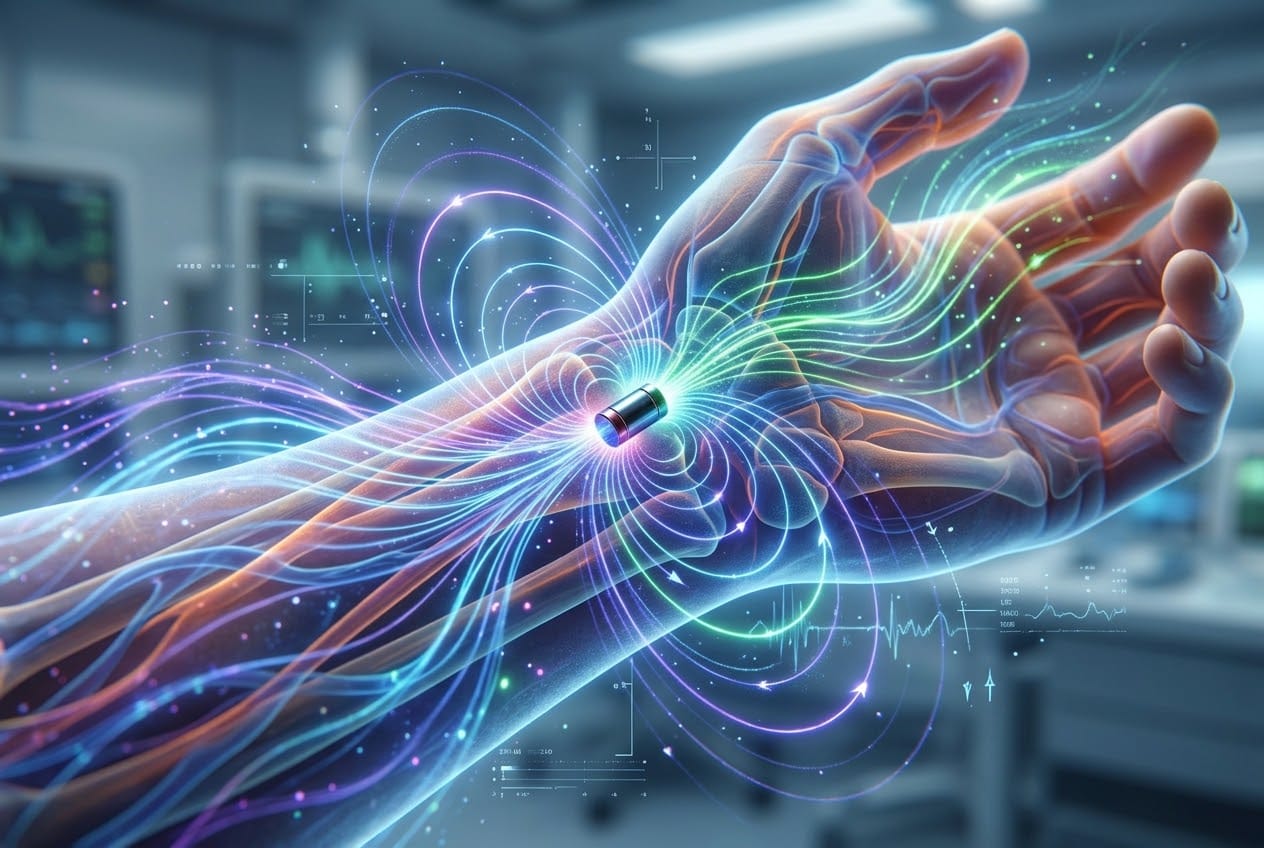
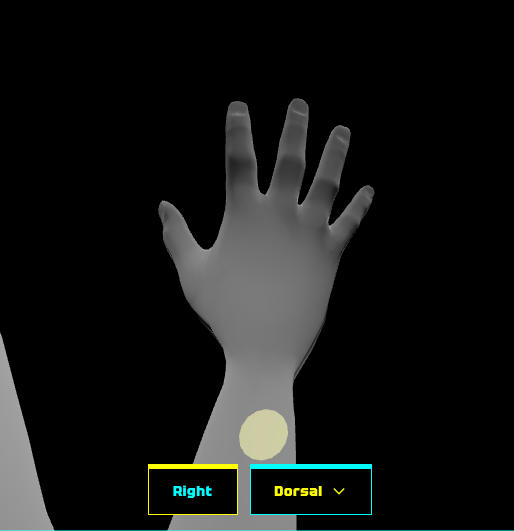
I recently had a Dangerous Things m1148a biomagnet implanted in my right wrist. A subdermal magnet does more than lift paperclips: it moves when an alternating magnetic field passes through it, and the surrounding tissue reports that movement as touch. That makes it both a passive field sensor and a receiver that an external coil can drive on purpose.
This post covers the hardware, the physiology, and a design for a Bluetooth-controlled electromagnet in a jacket sleeve that turns phone or PC notifications into vibrations only the wearer feels. The facts come from vendor documentation and published research, linked inline and listed at the end. The sleeve device is a design built on that prior art, not a finished build with measurements of my own.
The m1148a in numbers
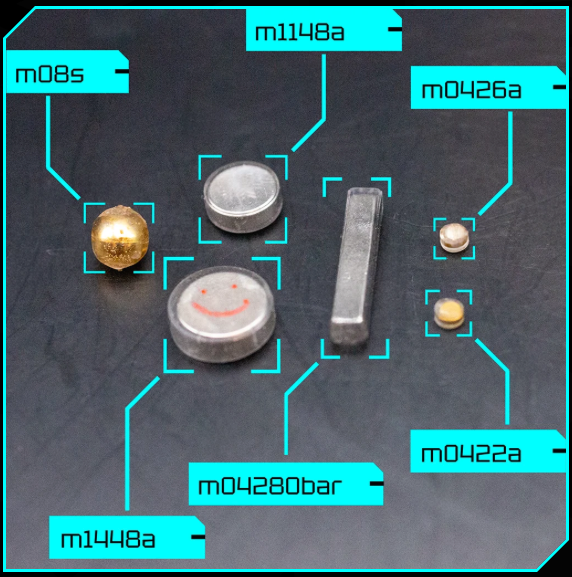
The m1148a is a resin-encased disc, 11 mm in diameter and 4.8 mm thick, around a 10 mm x 3 mm N52 neodymium core. The name encodes this: in the Dangerous Things m-Series scheme, the first two digits are the diameter in millimetres, the last two the height in tenths of a millimetre, and the suffix a means axially magnetized.
Property | Value | Source |
|---|---|---|
Finished size | 11 mm x 4.8 mm disc | |
Core | 10 mm x 3 mm N52 neodymium | |
Encapsulation | Resin | |
Magnetization | Axial (through the thickness) | |
Field strength | 2930 G, as measured by the vendor | |
Lift in vendor test | about 1.1 kg, second of the range | |
Install method | Scalpel |
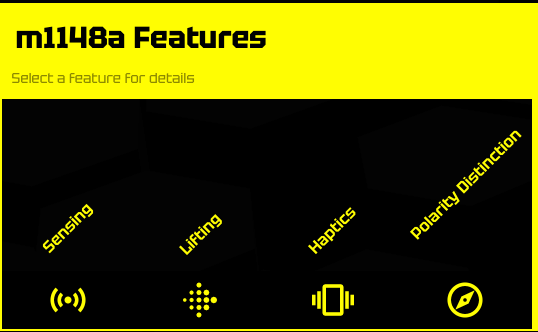
For scale, the range's dedicated sensing magnet, the m0422a, is 4 mm x 2.2 mm around a 3 mm x 1 mm N55 core and measures 1600 G in the same vendor test. The m1148a was announced in August 2025 as a lifting magnet, and the product page calls it the "more reasonable choice" next to the larger m1448a.
How a magnet under the skin becomes a sense
The implant has no electronics; it produces a sensation only when it physically moves. The Dangerous Things xG3 page says so directly: a magnet implant is just a magnet, and without movement there is nothing to feel.
The physics is standard magnetostatics. A uniform external field applies a torque that tries to align the magnet with it. A field gradient applies a net force. An alternating field reverses both every half-cycle, so the magnet rocks or shuttles at the field's frequency and the tissue around it reports vibration. Dangerous Things labels the two resulting haptic modes "Oscillatory" (small axial discs) and "Torsional" (the rod-shaped xG3 v1).
What detects the motion are the skin's four classes of mechanoreceptor. Their frequency bands, from a review of tactile actuators, set the usable signal range:
Receptor | Adaptation | Band (Hz) | Responds to |
|---|---|---|---|
Merkel's discs | Slow | 5–15 | Pressure, texture |
Meissner's corpuscles | Fast | 20–50 | Stroke, flutter |
Ruffini endings | Slow | 15–400 | Skin stretch |
Pacinian corpuscles | Fast | 60–400, most sensitive near 250 | Vibration |
Three published studies have driven implanted magnets with coils on purpose:
- Hameed, Harrison, Gasson and Warwick (2010) at the University of Reading built an external electromagnet interface for fingertip implants and measured field-strength and frequency sensitivity on two participants.
- Harrison, Warwick and Ruiz (2018) compared implanted subjects with subjects wearing identical magnets on the skin surface. The implanted group needed much smaller stimulation currents. Harrison's thesis describes 7 subjects per group, base frequencies of 20, 50, 100 and 200 Hz, and no group difference in frequency discrimination.
- Strohmeier and McIntosh (2020) actuated a roughly 2 mm x 4 mm Parylene-coated magnet in the first author's palm across 16 to 448 Hz. Frequencies below about 250 Hz felt stronger than surface-vibration data predicts, with a possible peak near 88 Hz. At about 100 Hz and below the sensation read as pushing or pulling; above that it turned sharp. The authors call the data preliminary: one participant.
Harrison's own description of mains-frequency stimulation, given to The Engineer: "The standard 50Hz feels like a buzz." His magnets were 3 mm x 0.7 mm discs.
Passive sensing uses the same mechanism with fields you did not generate. The vendor lists alternating current, motors, transformers and the polarity of other magnets as detectable. Interpretation is learned: Strohmeier and McIntosh cite anecdotal reports of weeks to months before environmental fields become readable.
What a wrist-mounted lifting magnet changes
The m1148a is sold as a lifter, and the wrist is a less sensitive site than a fingertip, so passive sensing should be weaker than the fingertip reports that dominate the literature. That is the main reason to pair it with a coil held directly over it.
Magnet class. Dangerous Things names the m0422a as its sensing magnet and the m1448a and m1148a as its lifters. Its sensing figure is quoted in G/g, which favours light magnets: 22,860 for the m0422a, 12,610 for the Titan, 2,590 for the xG3 v1. I found no published figure for the m1148a. The vendor's stated logic is that a sensing design wants high field strength and low mass, because mass adds inertia that damps the response. The m1148a's 10 mm x 3 mm core has about 33 times the volume of the m0422a's 3 mm x 1 mm core (my arithmetic from the published dimensions).
Site. MPCO's biomagnet primer notes that lifting magnets can go in areas with a low density of tactile corpuscles precisely because sensing is secondary for them. The nearest quantitative comparison I found is for surface vibration: a Southampton study cites Verrillo's finding that sensitivity to 250 Hz vibration is roughly 20 dB lower at the volar forearm than at the base of the thumb. It adds that forearm Pacinian corpuscles sit in deeper tissue, especially around joints and bone, yet still respond to surface vibration above 80 Hz.
What works in its favour. The force and torque a field exerts scale with the magnet's dipole moment, and the moment scales with core volume. A large magnet therefore pushes harder on tissue for a given coil field. Research implants outside the fingertip exist too: Strohmeier's was in the palm, chosen to keep it clear of climbing and of magnetically sensitive equipment.
No source I found reports detection thresholds for a magnet of this size at the wrist. Those numbers have to be measured on the person wearing it.
The covert channel: a coil in the cuff
The channel has four links: a host that sees the notification, a Bluetooth hop, a coil driver hidden in the jacket cuff, and the magnet itself. Nothing lights up, rings, or visibly moves.
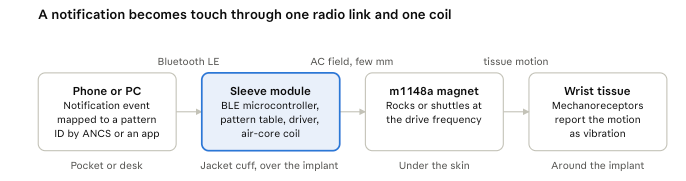
The sleeve module is the only part that has to be built; the host side is software and the last two stages are already in place.
Prior art
Every link in that chain has been built before, mostly for fingertip magnets. I found no published wrist-cuff version.
Project | Drive method | Detail worth borrowing |
|---|---|---|
Wire coil at the fingertip, current set by an ultrasonic range sensor | Signal strength encodes a quantity (distance) | |
Coil worn at the neck, homemade amplifier, audio signal | Any audio source becomes a magnet drive signal | |
Glove or bracelet with induction coils, Android apps | Wearable form factor, phone as signal source | |
Bluetooth 5.0 audio to stereo inductors | 1000 mAh lasts over 3 hours of continuous streaming; author flags Bluetooth audio latency | |
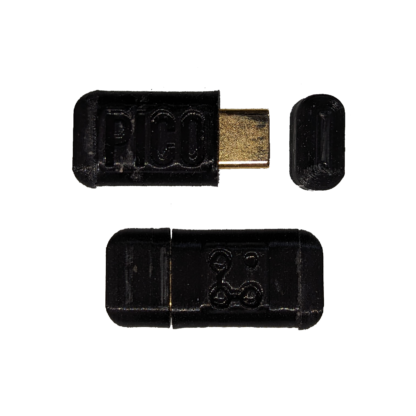
USB-C audio dongle, sold for $24.99 | Usage guidance: pole facing the coil end, implant within 1 mm |
The PICO was developed by Axel Fougues, and its design files are public under Apache-2.0. His Android app ZINC adds a "haptic lab" for trying waveforms and a set of standardized sensitivity tests, per the vendor's forum post.
Host side
There are two ways to get a signal to the sleeve.
Audio transport. The sleeve device presents itself as an audio output and the host plays a waveform. This is what the PICO and SMIS Cube do, and it needs no firmware logic. The costs: the SMIS Cube's author calls Bluetooth latency inherent and unsuited to real-time use, and the PICO's forum post notes that an audio device typically becomes the host's sole output.
Pattern transport over Bluetooth LE. The host sends only a short identifier and the microcontroller in the cuff synthesizes the waveform locally. On iOS this needs no app. The Apple Notification Center Service lets a paired accessory subscribe to a Notification Source characteristic. Each event carries an EventID (added, modified, removed), EventFlags (including importance), a CategoryID, a CategoryCount and a NotificationUID. Apple's caveats apply: access requires authorization, and the service is not guaranteed to be present at all times. On Android or a PC, a small companion program takes the same role and writes the pattern identifier to a custom characteristic.
For notifications, pattern transport is the better fit. It keeps the audio output free and moves the timing-critical part into the cuff.
Sleeve side
- Coil position. The PICO's 1 mm guidance shows how steeply coupling falls with distance. A cuff adds fabric and skin between coil and magnet, so the coil must sit directly over the implant and be held there. For scale, one published wearable reports a coil producing 4.09 mT peak at 5 mm from a 15 V drive.
- Coil orientation. With the coil axis along the magnet's axis, a field gradient pushes the disc in and out. With the axis across it, the field twists the disc. Which one reads better at the wrist is an experiment, not a known result.
- Core material. A magnet that lifts about 1.1 kg will clamp onto steel or an iron core through the skin. Dangerous Things forum members warn that sustained pinching between magnets leads to tissue necrosis. An air-core coil and non-ferrous hardware in the cuff avoid a standing clamp force.
- Power. The SMIS Cube figure is a worst case of continuous drive. Notification bursts are short and rare by comparison, so duty cycle, not capacity, sets battery life.
Designing signals you can read
The published data points to low-frequency, non-sinusoidal bursts as the starting vocabulary, calibrated per person. Treat the channel as a handful of distinguishable symbols, not a data link.
Parameter | What the sources report | Where to start |
|---|---|---|
Carrier frequency | Reading tests used 20, 50, 100 and 200 Hz. Strohmeier and McIntosh found sensation strongest below about 250 Hz, possibly peaking near 88 Hz, with a push-pull feel at 100 Hz and below | 50 to 100 Hz, then compare against 200 Hz |
Waveform | At 20 and 50 Hz, subjects told frequencies apart better with square and sawtooth waves than with sine | Square wave |
Amplitude | Implanted magnets need far less coil current than surface magnets. Harrison's thesis proposes weighting intensity by importance | Few coarse levels, set after threshold testing |
Timing | The gap needed to separate two pulses shifts with pulse length, frequency and cycle count. Subjects could count concatenated pulses | Encode by pulse count, with gaps well above your measured threshold |
The "where to start" column is my reading of those results, not a tested recipe. The studies used small fingertip or palm magnets, and none measured a wrist site.
A symbol set. The simplest scheme maps notification classes to pulse counts and reserves amplitude for urgency. ANCS supplies both inputs on iOS: CategoryID separates, for example, incoming calls from email, and EventFlags marks importance. A vocabulary of this kind matches the application Harrison's thesis proposes for the technique, tactile alerts weighted by intensity.
Richer encodings. A Dangerous Things forum thread speculates that a practised user could read sender and content in fast Morse code. I found no published test of Morse through a magnet implant, so that remains a hypothesis.
Calibration. Three measurements define a personal operating range, mirroring the Reading protocol: the weakest drive you can detect at each frequency, the smallest frequency step you can tell apart, and the shortest gap you can perceive between pulses. Repeat them after the implant has settled, because early readings will drift.
Limits and safety
The hard constraints come from the magnet, not the electronics.
- MRI. The vendor states that all its magnetic implants must be removed before any MRI or magnetic imaging procedure. Staff on the Dangerous Things forum put the official position as: not safe in an MRI machine at all.
- Other people's medical devices. The product pages rule out use near pacemakers and insulin pumps. A HeartRhythm case report documents a fitness-tracker wristband magnet switching an implanted defibrillator into magnet mode, and advises keeping such magnets at least 6 inches from the device. A wrist implant cannot be taken off, so that distance has to be kept deliberately.
- Regulatory status. The xG3 page states that none of these products is certified by any government regulatory agency for implantation.
- Encapsulation. The m1148a relies on its resin shell. The vendor retired the earlier m31 after its titanium nitride coating failed within a year. Wikipedia's summary lists corrosion after coating failure as a common cause of lost sensitivity.
- Pinching. See the core-material note above: strong external magnets and steel objects can trap skin against the implant.
- Settling time. The xG3 page gives 6 to 10 weeks to peak performance for that implant. I found no equivalent figure for the m1148a.
How invisible is it?
It is invisible to people nearby in the ordinary sense: no screen wakes, no sound plays, and the phone does not buzz on a table. Three qualifications apply.
- Radio. A Bluetooth LE peripheral is discoverable by anyone scanning for devices. The channel hides the content and the moment of delivery, not the existence of a device.
- Acoustics. Rich Lee's setup uses the same coil-plus-magnet principle to make audible sound from magnets near the ear. Whether a cuff coil driven at 50 to 200 Hz is audible to a neighbour is something to test, not assume.
- False positives. The magnet also responds to motors, transformers and other magnets. Distinct pulse patterns are what separate a message from the environment.
Evidence quality
The research base is thin: two participants in 2010, seven implanted subjects in Harrison's thesis, one in 2020, all with small magnets in the fingertip or palm. Everything here about an 11 mm disc at the wrist is extrapolation until measured. None of this is medical advice.
Sources
Access notes: the two Reading papers were available to me as abstracts only, and Harrison's thesis as its front matter and early chapters, so no numeric thresholds are quoted from them. Fougues and Kheddar's conference paper "Sub-Dermal Magnetic Implants for Haptics" could not be retrieved and is not used.
Vendor and community
- Dangerous Things: m-Series Biomagnets
- Dangerous Things forum: M1148a Now Available
- Dangerous Things forum: Dangerous Magnet Lift Off
- Dangerous Things: xG3 Injectable Biomagnet
- Dangerous Things: Titan
- Dangerous Things: Lodestone PICO and forum post
- Dangerous Things forum: Implanted magnets risk of pinch/injury
- Dangerous Things forum: Fingertip Titan in an MRI
- Dangerous Things forum: Magnet implant possible locations
- siliconbased.us implant catalogue
- MPCO Magnets: Biomagnets
- Axel Fougues: Lodestone-biomagnet-tools, SMIS Cube, BitSense
Research
- Hameed, Harrison, Gasson, Warwick: A Novel Human-Machine Interface using Subdermal Magnetic Implants, IEEE CIS 2010
- Harrison, Warwick, Ruiz: Subdermal Magnetic Implants: An Experimental Study, Cybernetics and Systems 49(2), 2018
- Harrison: Sensory enhancement, a pilot perceptual study of subdermal magnetic implants, PhD thesis, University of Reading
- Strohmeier, McIntosh: Novel Input and Output Opportunities using an Implanted Magnet, Augmented Humans 2020
- A Review of Smart Materials in Tactile Actuators for Information Delivery (mechanoreceptor table)
- Vibrotactile thresholds at the fingertip, volar forearm, large toe and heel, University of Southampton
- Millimeter-scale magnetic implants paired with a fully integrated wearable device, Science Advances
- Smart wearable device accessories may interfere with implantable cardiac devices, HeartRhythm Case Reports
Press and reference