
Video-to-Sim-to-Real: What Gemini 4 Argon's Cornhole Demo Means for Robotics

TL;DR
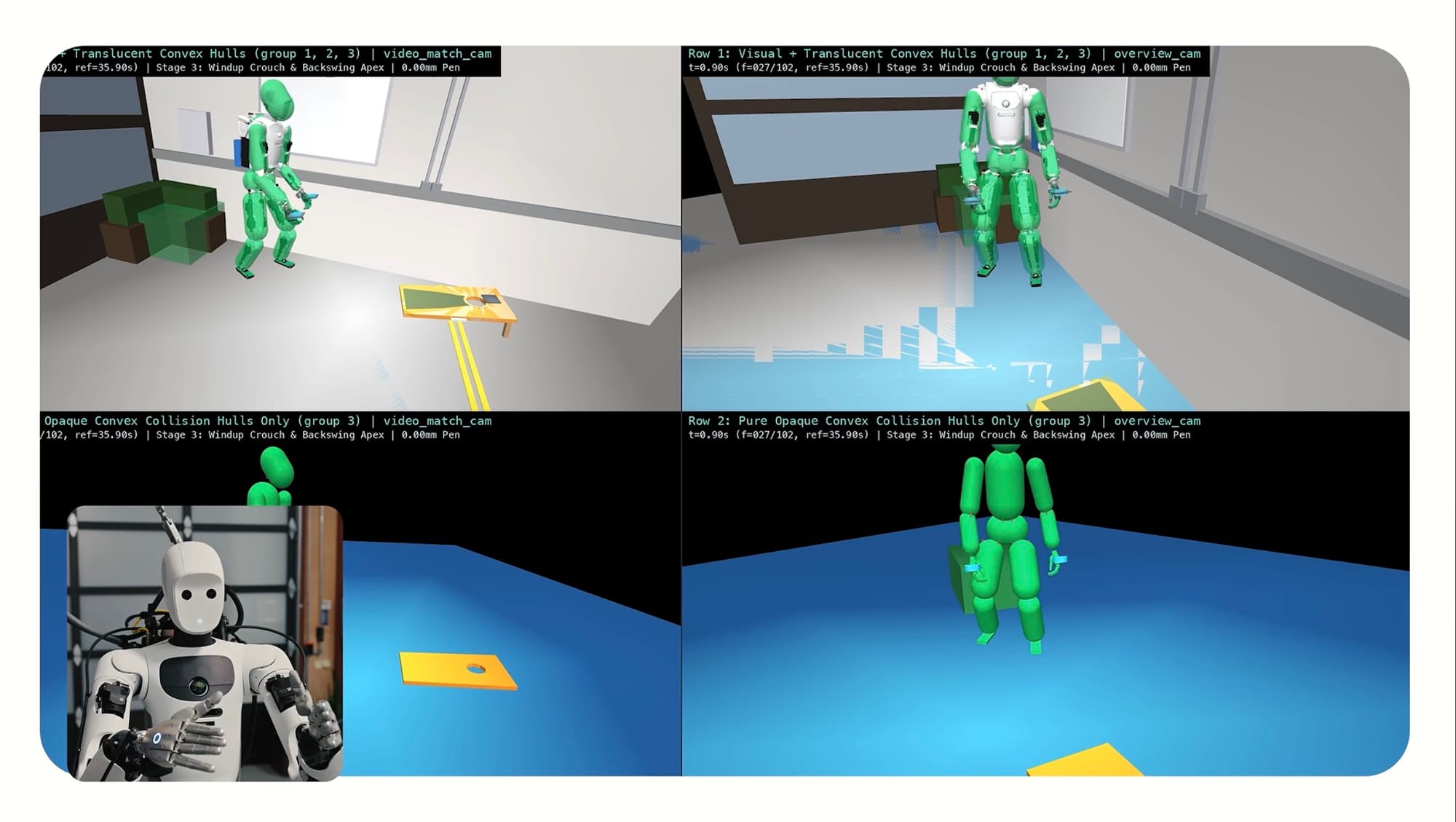
Google DeepMind fed Gemini 4 Argon one ordinary video of a person playing cornhole. Argon built a MuJoCo simulation from it, worked out the whole-body control, and Apptronik's Apollo 2 humanoid then sank seven consecutive shots on real hardware.
DeepMind calls this Video-to-Sim-to-Real and claims it compresses weeks of manual simulation modeling into a few hours. The interesting part is not the cornhole. It is a general-purpose frontier model doing the robotics engineer's job: scene reconstruction, simulation authoring, system identification and training, end to end.
The demo was published on Google DeepMind's YouTube channel on 13 October 2026, the day Google released its robotics write-up for Argon (video).
The pipeline: video in, controller out
The input was a raw clip of a human throwing cornhole bags: no motion capture, no robot data. Per DeepMind's video description and a researcher who ran the experiment, the model then did the following:
- Perceive. Use video understanding to map the board, bags and the thrower's motion, and reason about the physics of the throw.
- Build the sim. Author a MuJoCo scene of the task and the robot itself, as code.
- Identify the system. Run system identification so the simulated dynamics match the real hardware.
- Train in sim. Compute the whole-body joint motion for Apollo 2 and practice the launches in simulation.
- Transfer and refine. Execute on the real robot, then improve after a few real throws. Result: seven consecutive made shots.
The Gemini 4 Argon for Robotics developer post, by Kanishka Rao, shows the same Real2Sim machinery in reproducible prompt form. Argon can reconstruct calibrated MuJoCo twins from three sources:
- Robot teleop episodes: tunes asset geometry, mass, inertia and friction until sim camera renders and fingertip contact forces match the logged real data. The prompt explicitly forbids "sim cheating" such as injected forces or rolled-back object state.
- Egocentric human video: convex-decomposes object meshes and retargets human hand keypoints onto a 76-DoF bimanual humanoid with 22-DoF hands, stepped at 500 Hz.
- Paper sketches: builds a
mujoco_warpscene for Apollo 2 throwing a ball at a box pyramid, with a balanced whole-body throw verified at under 3 cm pelvis drift.
The cornhole demo is effectively the human-video and throwing workflows combined, closed through real hardware.
What it means for robotics
Simulation authoring stops being the bottleneck. Sim-to-real has always depended on someone hand-building the scene: geometry, collision meshes, mass, friction, contact parameters, then tuning until sim matches reality. Argon writes that MJCF and tunes it against real observations. If Google's weeks-to-hours claim holds outside the lab, the marginal cost of a new simulated task drops sharply.
Ordinary video becomes a training-data source. Robot learning is starved for data. Teleoperation is slow, and internet video has no physics attached. A model that turns a phone clip into a physically solvable environment converts passive video into something you can run RL or trajectory optimization against. DeepMind's own framing is an "infinite training ground" for physical AI.
Synthetic data measurably helps VLAs. In a separate experiment, Argon built a MuJoCo twin of a bimanual Franka FR3 workspace from a single photo, defined a 77-task curriculum and generated 4,500+ domain-randomized episodes for VLA fine-tuning. Real-robot success rose from 56% to 75% and completion time fell from 35 s to 24 s. Some coverage attributes these numbers to the cornhole run; Google's post ties them to this tabletop experiment.
Argon is the offline layer, not the control loop. Argon is a hosted general model without Live API support. In Google's stack it sits beside, not instead of, the robotics models:
Layer | Model | Runs when |
|---|---|---|
Sim building, data generation, labeling, planning code | Gemini 4 Argon ( | Before the robot moves |
Real-time reasoning, success detection, task orchestration | Gemini Robotics ER 2 (incl. streaming endpoint) | While the robot moves |
Camera-to-motor control | Gemini Robotics 2 (VLA) | While the robot moves |
Offline on-robot inference | Gemini Robotics On-Device 2 | While the robot moves, no network |
The cornhole result fits this split: the hardware throws ran a controller trained in Argon's simulation. Google has not published how much of the real-world refinement step Argon drove itself.
Caveats
- One internal test. Seven consecutive shots is a single run in a controlled setup. No trial count, miss rate or generalization data has been published.
- Vendor numbers only. The weeks-to-hours claim, the 56% → 75% uplift and the 87% ERQA score are all Google-reported. None has independent replication yet.
- No latency figures. Google publishes none for Argon in robotics. Its control demos run turn by turn, so closed-loop use at control rates remains unproven.
- Benchmarks don't compare across pages. Argon's ERQA chart and the ER 2 page use different model sets and harnesses, so the numbers can't be subtracted.
- The sim-to-real gap is narrowed, not removed. The demo still needed system identification and real throws to refine. Unmodeled contact, wear and environment variation still have to be handled on hardware.
The practical takeaway: treat Argon as a tool for building simulations and data before the robot moves, and validate on hardware as you always would.
Sources
- Teaching a humanoid robot to play cornhole with Gemini 4 Argon (Google DeepMind, YouTube, 13 Oct 2026)
- Gemini 4 Argon for Robotics (Kanishka Rao, Google Developers Blog, 13 Oct 2026)
- Gemini 4 Argon Turned a Cornhole Video Into Seven Real Shots (Humanoid Press, 14 Oct 2026; includes the DeepMind researcher's account of sysID and real-shot refinement)
- Gemini 4 Argon for robotics: what it does, what it costs, what it can't (eesel, 14 Oct 2026; Argon vs ER 2 positioning and Live API support, per Google's docs)